shivam@portfolio:~$ cat README.md
shivam@portfolio:~$ cat notes.md
Where trust ends
Everything below the browser is assumed hostile. That assumption drives three choices that would otherwise look excessive:
- The master password is never transmitted. The server receives an Auth Key, a separate HKDF branch of the Master Key, and stores only an scrypt verifier of it.
- All entry content is encrypted client-side, including names, tags and folder names. The server cannot read, search or index any of it.
- Email addresses are stored as HMAC digests under a pepper kept outside the database, so a dump does not identify account holders.
Key hierarchy
Master password + per-user salt
        │ PBKDF2-SHA256, 600,000 rounds
        ▼
   Master Key ──┬── HKDF "vault.kek.v1"  ──► KEK ──► wraps the Vault Key
                └── HKDF "vault.auth.v1" ──► Auth Key ──► server (scrypt verifier)

   Vault Key (random, generated once)
        ├── wrapped by the KEK            (master password)
        ├── wrapped by the Recovery KEK   (recovery key)
        └── encrypts every field, AES-256-GCM, fresh 96-bit IV
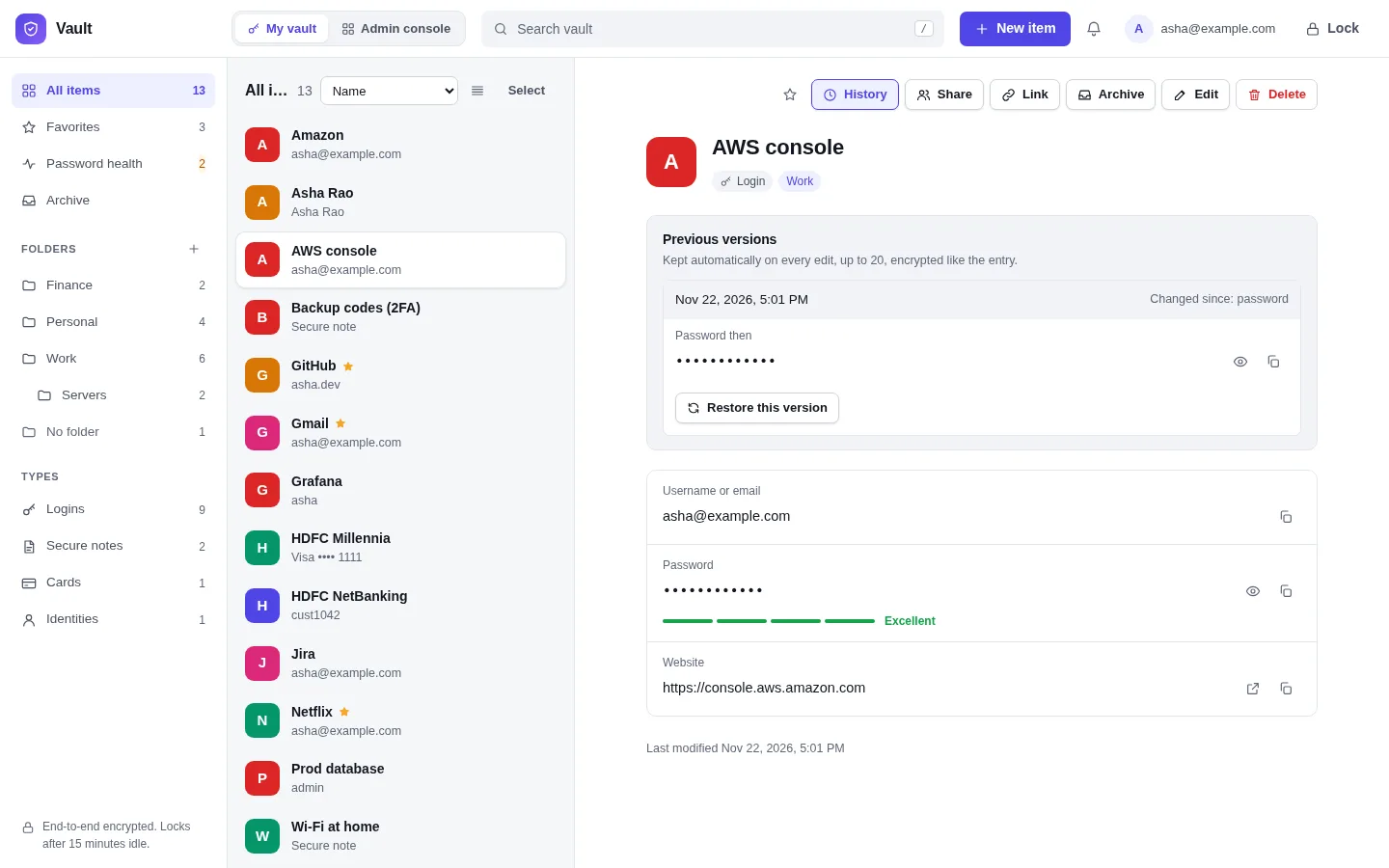
Because a random Vault Key encrypts everything and the master password only wraps it, changing the password is a single write: nothing is re-encrypted and history survives. A recovery key, shown once at sign-up, is the only way back from a forgotten password — there is no reset, because the server cannot perform one.
Each account also has an ECDH P-256 identity key pair, which is how a collection key reaches a colleague without the server learning it.
The risk accepted on purpose
The hostname is a free dynamic-DNS name, and it is the whole user-facing trust path: whoever controls that name could serve their own JavaScript, which would see the master password. Unlike a server compromise, that is not bounded by the key hierarchy. It is written down in the threat model and accepted knowingly for a $0 deployment, rather than hidden.
shivam@portfolio:~$ ls -la
# More about Vault — zero-knowledge password manager
total 1