
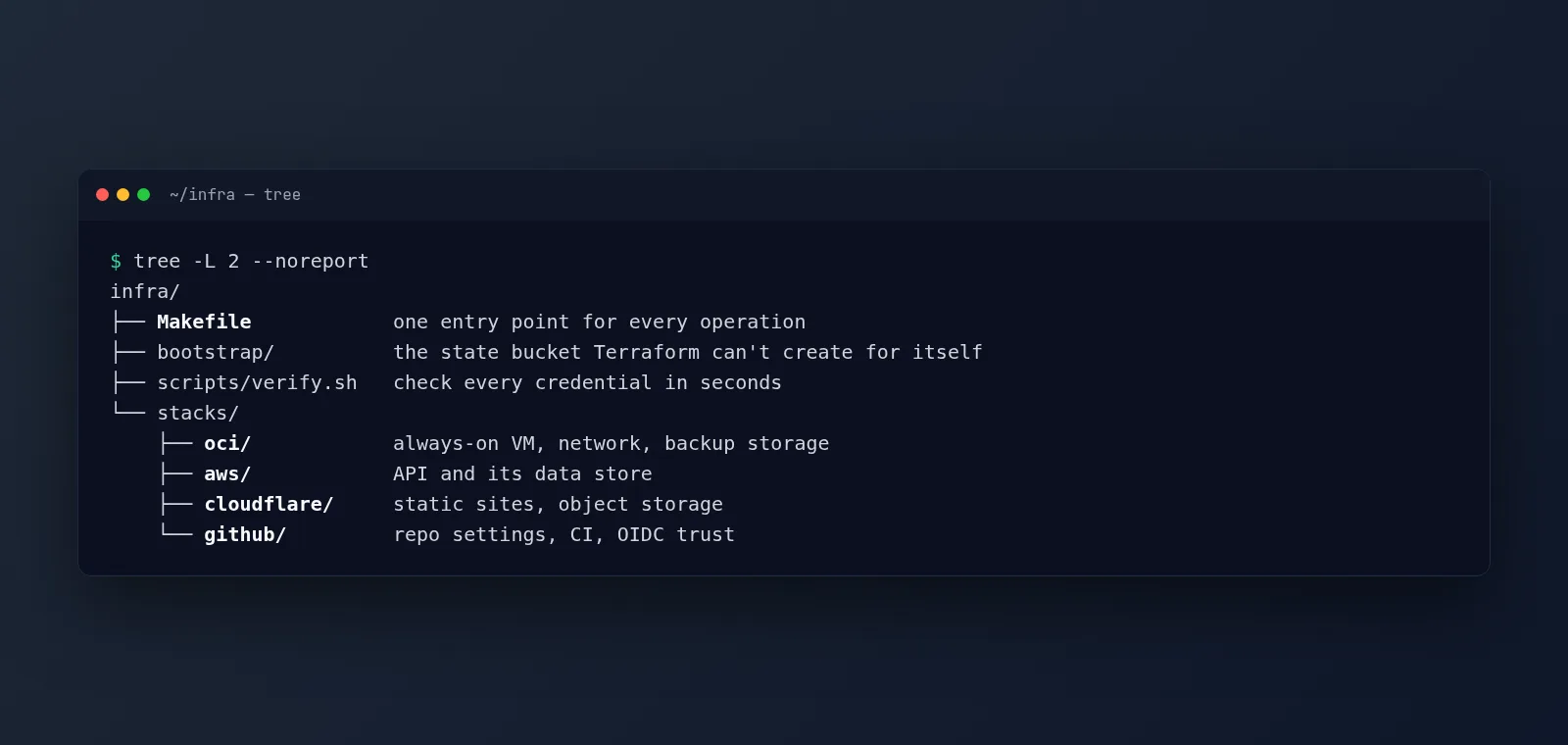
Each stack owns its own state
Never reference one stack's resources from another through remote state. If two stacks need the same value, it is passed as a variable. Cross-stack references would recreate exactly the coupling this layout exists to avoid.
terraform.tfvars is never committed
Copy terraform.tfvars.example and fill it in. Credentials come from each provider's own config (~/.oci/config, ~/.aws/credentials, CLOUDFLARE_API_TOKEN, gh auth), so nothing secret ever lands in git.
Free-tier constraints are load-bearing
Several resources have settings that must not drift: capacity modes, absent VPC attachments, specific billing modes. Each one is commented where it applies, with the reason. Changing one of them is how a free estate starts costing money.
Nothing here creates content
This repository manages infrastructure and settings only. Application code and site content live in their own repositories, so destroying a stack never destroys work.